
Big beat in Nowa Huta - the beginnings, 1960-1963. How AMETYSTY ("The Amethysts") came into being.
As I remember it today, in 1960 at the 12th Secondary School Jerzy Ochoński and Witek Robotycki formed a Dixieland band. The line-up: Witek Robotycki - trumpet, Jerzy Ochoński - trombone, Zbigniew Irzeński - clarinet, Wacław Kraszewski - drums /I think/. I do not remember the rest of the line-up. At the 11th Secondary School, at the beginning of 1960, Bogdan Podermański, who played the clarinet, talked Marian Malinowicz into playing the trumpet, my humble self into sitting down at the piano, Jacek Jaworski into playing the drums /the school had a set/ and Łukasz Kozioł into playing the acoustic guitar. While Podermański and Malinowicz had been through a primary music school or the music centre /at that time it was above the boiler house on the Centrum B estate/, I, Jaworski and Kozioł were self-taught. I also sang, accompanying myself on the guitar /Only You, Diana, It's Now or Never, that is the Italian O sole mio/. Tadek Gogosz went to our school too; he played a bit of clarinet, I do not remember him playing the guitar.
This lasted until June 1961. Then we all began our studies, at different colleges; we lost the school as our place to practise, and so our paths parted. We never played together again. In September 1961 I became the owner of a tenor saxophone, and more and more often Tadek Gogosz and I began to think about putting a band together.
Before New Year's Eve 1961/1962 we rehearsed in the line-up: Tadek Gogosz - electric guitar /he played it like a bass, plugged into a radio set/, Adam Komenda - piano, Andrzej Sojka - drums /he soon made a career, but as a handball player in first-division clubs/, and me on tenor saxophone. The rehearsals took place at the "Violinka" club. On New Year's Eve 1961/1962 we played in Bielsko-Biała. By the way, this gig was arranged for us by Włodzimierz, Kazimierz and Mieciu Biela. The first two were well-known boxers of Hutnik and the Polish national team, and the manager of the club where the party was held was the aunt of the Biela brothers. As we had been told that the company would be mixed /young people and older ones/, we co-opted an accordionist, Rysio Borowiecki.
My memories of that New Year's Eve are thoroughly positive, judging by how pleased the guests were. A sign of their satisfaction was the considerable amount of alcohol we were given by the guests and took back to Kraków. The beginning of 1962 was the reign of the twist around the world, and in Nowa Huta /probably on the model of Czerwono-Czarni/ Jurek Ochoński formed /so it seems to me/ the first big-beat band. He himself was by then playing tenor saxophone, Zygmunt Schornstein certainly played guitar, and Wacek Kraszewski drums /I think/. I do not remember the rest of the band from the earliest period. Later on the lead guitar was certainly played by Leszek Trojanowski. The line-up probably kept changing, and when the band began to play at the so-called "fives" in the Wisła sports hall it took the name "BIAŁA GWIAZDA".
With no disrespect to anyone in the band, it seems to me that its uncrowned leader was Jurek Ochoński. Even if it was otherwise, for me and probably for the rest of our band he was an exceptional figure. At the beginning of 1962 Tadek Gogosz and I brought into the band Sławek Butenko on piano, Marian Plutecki /at first on drums/, later on lead guitar, and Zdzisio Nazarko on drums. We took the name I had suggested, AMETYSTY; to tell the truth nobody liked it, but in the end it stayed. Throughout 1962 we played at dances /"ubawy", as they were called then/ at the Violinka, upstairs and downstairs, and after Biała Gwiazda emigrated to Kraków we moved to the House of Culture on Majakowskiego Street and played the "fives" /so called because they started at 5 in the afternoon/ at the so-called Song and Dance Ensemble on the Górali estate. On New Year's Eve 1962/1963 we played, with success, at the Skawina Power Station.
At the beginning of 1963 we were still playing at the Song and Dance Ensemble.
Here, during the "we are looking for young singing talents" contests, we discovered Staszek Zatorski /incidentally, a genuine Pole of mixed race/, who sang twists sensationally, in the manner of Chubby Checker. He soon became our soloist, much liked by our fans. After that he brought along the third guitarist we lacked, Wiesiek Wilczkiewicz, the unforgettable performer of the solo hits of The Shadows. Before long we auditioned and took into the band a very pretty and attractive girl, Elka Żakowicz, with a strong, lovely and clear voice.
In the spring of 1963 the band was offered the chance to play at the student club Pod Jaszczurami. On the one hand we were glad we would be playing in the best club in Kraków; on the other, it was with regret that we left HUTA, where it had all begun.
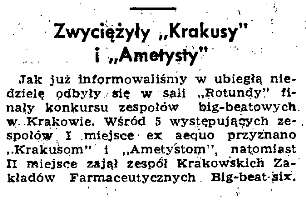
Just as we had inherited first place in Nowa Huta from Biała Gwiazda, after us the number one was probably Ryszardy /or perhaps I am wrong/. Ametysty were joined by the soloists Rysiek Horuz, Janusz Sołek, and, I am sorry to say, Ela Żakowicz left. In June we took part in the contest of Kraków big-beat bands. The competing bands were: Krakusy with Wiesia Bator and Jurek Gurgul, Biała Gwiazda with Elka Żakowicz, until recently ours, Piątka +, and Ametysty with Horuz, Zatorski and Sołek /vocals/.
The official result was favourable for AMETYSTY, but I always thought it was unfair. I will not comment on it any further. In May 1963 we played at the "JUWENALIA" student festival, and the title of Kraków's most charming student of A.D. 1963 went to Anna Seniuk. For us the high point of those Juwenalia was the trip to the students' tuberculosis sanatorium in Zakopane. Nothing much, it might seem, but we travelled and performed together with "PIWNICA POD BARANAMI" and with the folk group "GÓRALE" from the AGH. Throughout that escapade we were accompanied by the newly chosen most charming student of Kraków, Anna Seniuk.
In June we performed on the Main Square during the "Days of Kraków" celebrations. An exceptional experience for us was having our performance recorded by television from West Germany, a country on the other side of the wall. All summer we played at the so-called Interklub Jaszczury, where in the summer season students arriving from all over the world came to have fun. It was a very pleasant, if tiring, time.
As a curiosity, I remember that a Swedish student recorded us for a pirate radio station. In those days such stations broadcast from ships moored outside the territorial waters of states /hence pirate/. Few people remember that today. The student had a holiday for free /how I envied him/. In September 1963 Wiesiek Wilczkiewicz was replaced by Leszek Trojanowski, and Andrzej Ibek joined on the melodica /we called it a blown mini piano/. After the holidays we played at Jaszczury on Saturdays and Sundays and on Thursdays at the Jazz Klub Nowa Huta /where the Nursing Secondary School on Kocmyrzowska Street was later/, so for concerts out of town and, of course, rehearsals we had the remaining days of the week.
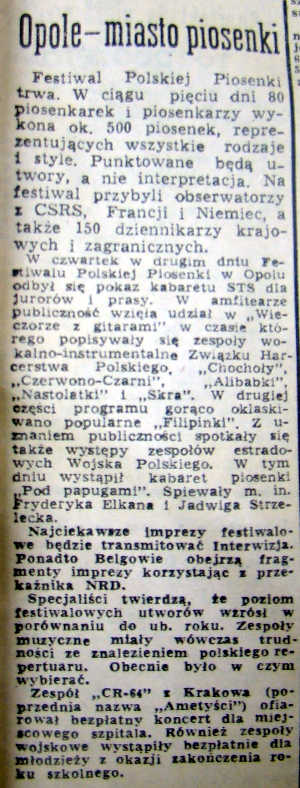
It happened that there was not a single free day in the week. We gave concerts around the province, mainly the Kraków one: Wadowice, Chrzanów /the fans broke the chairs - out of delight, of course/, Nowy Targ, Nowy Sącz, Krynica, Jaworzno, Krzeszowice-Czatkowice, Tarnów, Rzeszów. And in the autumn we went with the GÓRALE group to perform in Opole and Ozimek. Who organised it and on what occasion, unfortunately I do not remember. As a curiosity, I remember that a poster in Tarnów /not ours/ carried the words "singing: Stanley Zatorson - a black man". This annoyed our Staszek a little, but as he came from a family of so-called "tumiwisists" (people who could not care less), his anger soon passed.
We can also boast that in this period the lyrics of some of our songs were written by the unforgettable Wiesiek Dymny. I am sorry to say that I used to have the manuscripts of some of his lyrics. Unfortunately, today I know that I only used to. As I have said, the whole week was filled with playing, and the band was drifting strongly towards turning professional. I was in the third year of the Faculty of Mechanical Engineering of the Kraków University of Technology, the hardest year of that course, and something had to be chosen as the priority. In November 1963 I left the band, in a not entirely pleasant atmosphere. Well, in this business that is simply natural. A cluster of strong personalities has to part sooner or later. To this day, though, I sometimes meet the living members of the band; we reminisce and miss those times.
And what are the "dinosaurs" recalled here doing today?..
Tadeusz Gogosz, after playing in Szwagry, CR-64, Bemibek and Akwarele of the late Niemen, settled in Norway, took an engineering degree and is a specialist in non-destructive testing of offshore steel structures. Sławomir Butenko, after playing in Szwagry and CR-64, set up a textile wholesale business. Wiesław Wilczkiewicz still plays the guitar and is now in the USA. Marian Plutecki - no news. Zdzisław Nazarko - deceased. Ryszard Horuz - no news. Janusz Sołek lives in the USA. Elżbieta Żakowicz, a soloist with many bands, including Wiślanie 69, lives in Kraków. Adam Komenda, sadly, is no longer alive either. Andrzej Sojka, after ending his handball career and as a graduate of the Kraków University of Technology, worked at the Lenin Steelworks, then as a designer at Mostostal Kraków, and for the past 30 years has been a designer in Chicago.
Ryszard Borowiecki, a graduate of the music school in Nowa Huta in the accordion class, is now a professor and the Rector of the Kraków University of Economics. Stanisław Zatorski sang in Szwagry, CR-64 and in the band of Zygmunt Wichary from Katowice; at present I have no news. Bogdan Podermański graduated from the AGH with a doctorate in engineering, lectured at a university of technology in Nigeria, and now runs a company in Kraków. Marian Malinowicz studied law - no news. Jacek Jaworski began his studies at the Kraków University of Technology and finished them at the Gdańsk University of Technology; for many years a judoka of AZS Kraków /I think/ and Wybrzeże Gdańsk. Łukasz Kozioł - contact was lost after the school-leaving exams. Leszek Trojanowski is a well-known stomatologist /a dentist, as we say/ in Kraków. As he says himself, "he is the best guitarist among dentists and the best dentist among guitarists". Andrzej Ibek, co-founder of the band BEMIBEK, is now a teacher of history and geography in Stockholm. Krzysztof Partyka - after I stopped playing in Ametysty I played briefly, on occasion, with Czarne Perły at the Rotunda student club /a weakness for jewellers' names, I suppose/.
For the rest of my studies my friends and I formed a hiking-and-feasting group called TUMIWISIŚCI, genuinely amateur but fun. After graduating I took a job at the Lenin Steelworks, later the Sendzimir Steelworks, in the Welded Tube Mill. The work at the tube mill also gave me a great deal of satisfaction and pleasure, just like the music-making episode described earlier. Here I met one of the dinosaurs of the big beat of the sixties and the author of this website, Ryszard Szczudłowski. We worked together for 27 years.
Allow me at this point a small aside about Rysiek. At work he proved to be a very reliable and creative master electronics technician. "Disgustingly" logical, with vast knowledge of electronics and an inborn ease in solving electronic problems. That is exactly why he was and is respected both by the workers under him and by all the management teams that ran the tube mill over the years.
He is the author of more than 80 improvement projects and 4 patents, and in his last period of work he wrote several computer programs, four of which are in use in the military department DNW. What I have written here is entirely true, because for many years I was his superior and I remember that period of cooperation very fondly. What kind of specialist he was, let the following incident testify.
Years ago there was an electronic breakdown at the tube mill. Half the mill stood idle for a day and a night. Rysio was in hospital at the time. So he was brought out of hospital, and two hours later the equipment was working again. I have written this because I felt the picture of him was incomplete. We know him as a guitarist and as the author of the website, so I have added this missing third side. He simply deserved it. As for myself, I have been retired since 2005. An occupation that is not very exhausting but terribly boring. For all the friends mentioned here and for posterity, these memories were written down by
Krzysztof Partyka, Kraków 2010
P.S. If there are any inaccuracies, I apologise and ask for corrections. I encourage the other friends to make similar confessions, drawing on the memory we still have /I know what I am saying/. Perhaps one day it will interest someone..
Line-up:
lead guitar - Lesław Trojanowski // Jerzy Tarsiński // Marian Plutecki
bass guitar - Tadeusz Gogosz d. 2019
rhythm guitar - Wiesław Wilczkiewicz
tenor saxophone - Krzysztof Partyka // Zbigniew Irzeński session
melodica, clarinet - Andrzej Ibek
piano - Andrzej Kunz // Adam Komenda // Sławomir Butenko d. 2021
drums - Marian Plutecki // Zdzisław Nazarko
vocals - Stanisław Zatorski (vel Stan Zatorson), Ryszard Horuz, Janusz Sołek, Włodzimierz Gurgul, Elżbieta Żakowicz
manager - Igor Jarecki
Below: surviving photographs from the group's performances
Click to enlarge


- material provided by Krystyna Downar
- material provided by Paweł Gradek


2003 - 2026 Kraków