
|
RYSZARDY - the band's chronicle
Roots .... September 1962.
It all began with Jurek Mondrzyk....
During a school trip by train to Zakopane, on the occasion of the so-called Lenin Rally, a group of schoolmates - carried away by the hit songs Jurek sang to his guitar on the train and off it (Twist Again, Diana...) - decided to start a band. The line-up was initiated by: Jerzy Mondrzyk - cornet, guitar, piano, Eugeniusz Grzesiak - drums, Ryszard Binias - melodica, accordion, and Ryszard Szczudłowski - guitar. It is to Jurek that I owe my love of playing and my first insight into the secrets of the guitar. 
1962 - Zakopane: in front of the great ski jump
the historic trip that started the musical journey of the band later known as Bezdomni, RyszardyIn the photo, among others: Ryszard Zapart, M.A., Teresa Styn, M.A., Edward Lachowicz, Jerzy Mondrzyk, Ryszard Przechera, Stanisław Markowicz, Ryszard Jakubowski, Kazimierz Markowski, Józef Kulas... 
1962 - Łańcut
the historic trip that started the musical journey of the band later known as Bezdomni, Ryszardy. Rysiek Przechera - on the left - is holding the guitar of Jurek Mondrzyk, from whose neck I later built my own "Fender" (Film 1964).In the photo, among others: Teresa Styn, M.A., Jerzy Mondrzyk, Ryszard Przechera, Ryszard Binias, Stanisław Markowicz, Ryszard Szczudłowski, Andrzej Antkowiak, Tadeusz Stefański, Marian Plutecki, Eugeniusz Grzesiak
The band's first rehearsals took place at school, and anniversaries and school occasions gave us the chance to appear in public. Our first performances at events were in the cinema and theatre hall of the steelworks. This was possible thanks to the contacts and good relations that the band's music instructor had with the management of the works. Mr Edward Lachowicz - the instructor - played along on the violin and was at the same time the band's manager in those days. Thanks to his personal commitment many technical and organisational difficulties were overcome.
1963 
Because some of us had earlier played in a Dixieland band at the club, the first real rehearsals began to take place there - it was the right home. In the meantime the band grew by several people. In that club, for almost the whole of 1963, the band practised and played in the line-up Gienio Grzesiak, Jerzy Mondrzyk, Jerzy Konieczny, Ryszard Jakubowski, Stefan Rzytki, Eugeniusz Jakubowski, Ryszard Binias, Ryszard Szczudłowski.
Stefan Rzytki, Eugeniusz Jakubowski and Ryszard Jakubowski - spending their nights with Radio Luxembourg (UK) - wrote Polish words to the Beatles' songs, worked out the vocal parts and laboured over the arrangements. Painstaking work. What we had to go on was always a recording made mainly from that station, or belated recordings from "sound postcards" (flexi-discs). Everything was obtained by every possible means.
 Stefan Rzytki 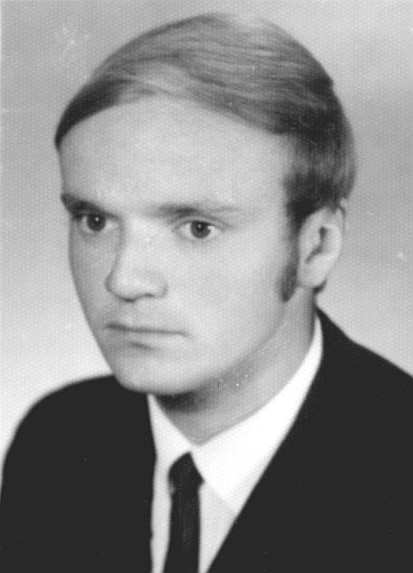 Ryszard Jakubowski  Bogdan Wells
For a time the group was joined by the visual artist Bogdan Wels, accompanying on the biggest instrument of all - the double bass. He also acted as the club's music instructor.

Fascinated by the style and the music, the band was slowly heading towards an instrumental line-up: 3 guitars + drums - modelled on the English guitar group
The Shadows.
The band's ambition was to play like that group and to play its repertoire.
The band's repertoire and playing style were based on the English groups mentioned above. We played on whatever we had, and the chances of getting real equipment were slim. At first I played a "Fender Fifka" fitted with the neck of the Czech guitar of Jurek Mondrzyk, later a real Czech Jolana Star. Before long everyone had Czech instruments: Jolanas, Futuramas or Graziosos.
At the same time the Violinka club was home to the bands Biała Gwiazda and Ametysty, with whom we took turns playing at the evening dances for young people. Throughout the time the instrumental line-up was at work, the lack of proper equipment was a nagging problem.
The time came when the club's management took a dislike to long hair and grew tired of the group's miaowing, wailing and.. hairstyles. As a result the band was given an ultimatum by the management: either change the hairstyles or... For some time there was no home, no equipment and no prospects.. A time of meetings at home and among friends followed, and of longing to play again. There was a spot on Aleja Róż - close to where the band members lived - where we sat on the benches humming and practising our voices, to our own delight and that of the passers-by.. On the way back from the last rehearsal at the Violinka club Gienek Jakubowski suggested giving the band a name that fitted the situation it found itself in, namely Bezdomni (The Homeless). In those days there were officially neither homeless nor unemployed people, so.... showing off one's homelessness in public was not welcomed by the so-called authorities or by the club's management. Part of the group stayed at the Viola and took the name Bezdomni - after a book on the school reading list - carrying on with its music. Because of the quarrels with the club's management over the name, the remaining group - Bezdomni - after a while changed its name to Wiślanie, and later changed its line-up many times as well. 
1962
the early 1960s, the beginning of Aleja Róż seen from Plac Centralny. On the right you can see parked cars; next to them was a bus stop, and around the red roses, ringed by white ones, stood the benches - it is very old history; around the square you can see trees that probably no one remembers any more..

Later years
The same place a few years later..
1964/1965 From the late spring of 1964, for several months, the band Czarne Diamenty played at the evening dances for young people at the ZPiT (the Song and Dance Ensemble) in place of Czarne Koty, who had broken up. For us (Bezdomni) fortune only smiled towards the end of 1964. The group, in the line-up Gienio Grzesiak, Jerzy Konieczny, Ryszard Jakubowski, Stefan Rzytki, Eugeniusz Jakubowski, Ryszard Binias, Ryszard Szczudłowski, 
found a home at the ZDK (the steelworks' House of Culture) and was able to use the equipment on which Czarne Koty had played. Rehearsals began in the famous room 28, where the artists of the song stage directed by Tadeusz Koćma also practised. Famous because - despite the management's consent - there were always negotiations with the porter over getting the key to it. He had his own, "democratic" attitude to the kinds of music we presented..

After some time, and after all sorts of discussions, the next line-up took shape and the group carried on working as: Ryszard Binias - drums, Gienek Jakubowski - rhythm guitar, Ryszard Szczudłowski - lead guitar, Jerzy Konieczny - bass guitar, and the singers: Ryszard Jakubowski and Stefan Rzytki. 
1964 - the "Ionika" organ
The "Ionika" organ with its amplification, which the ZDK received as a gift from its "sister" town in East Germany - Neuehuttenstadt. The first model of electronic organ built in East Germany, in 1961/1962. Although the loudspeaker was only 12.5 W, the sound of the equipment was sensational for those days.

Telefunken Echomixer
The three-channel TELEFUNKEN Echomixer with a two-spring Hammond system was a sensational effect in those days. The Echomixer belonged to the guitarist Felek Naglicki of the band Skaldowie, who later played with this effect. Its sound can be heard on their first recordings: "Wieczorna Opowieść", "Czarownica". It was also used by Czarne Koty (1964).
After some time part of the group Czarne Koty left for military service, while Marek Jamrozy remained "to be taken care of" and became a member of the band. Today I no longer remember exactly whether it was Marek Jamrozy who was taken into part of our band or the other way round. Felek Naglicki had something nobody else in Kraków had - a Telefunken spring echo-mixer. Music played with this effect, which Marek Jamrozy borrowed from Felek Naglicki, made a huge impression. Later the mixer was used by Skaldowie. From Czarne Koty we "inherited" an amplifier and the organ (the first East German model), a sensation for those days. For several months, from September to the end of February 1965, the group worked in the line-up: Marek Jamrozy - lead guitar, Ryszard Szczudłowski - rhythm guitar, Jerzy Konieczny - bass guitar, Ryszard Binias - drums. The turn of 1964/1965 meant working at the ZDK of the Lenin Steelworks. Occasionally we accompanied the stage artists of the House of Culture (Stanisław Florek, Czesław Popielarczyk..)  Andrzej Zieliński There were many events and performances commissioned by various institutions, and big beat as played by the band even reached the underground chambers of the Wieliczka salt mine. In the early period our music instructor was Andrzej Zieliński. Sometimes -  Marek Jamrozy
despite his many other commitments - he even managed to play with us. He left later - as far as I remember - because of his involvement in forming Skaldowie. Later on Marek Jamrozy left too, for Szwagry and then for Skaldowie.
 Asia Makiej  Czesiek Popielarczyk  Roma and Jola Doniec At the beginning of the year the band was joined by the singer Joasia Makiej and by Czesław Popielarczyk as a vocalist. Later, too, the band was accompanied at performances and events by the sisters Roma and Jola Doniec, singers of the ZDK song stage. 
At first the group appeared as the music group of the Lenin Steelworks House of Culture. In 1965 it took the name Ryszardy (The Richards), after the considerable number of its members who bore that first name: Ryszard Binias, Ryszard Jakubowski and Ryszard Szczudłowski. The other members of the band were Jerzy Konieczny and Eugeniusz Jakubowski. The singers were Ryszard Jakubowski and Stefan Rzytki.

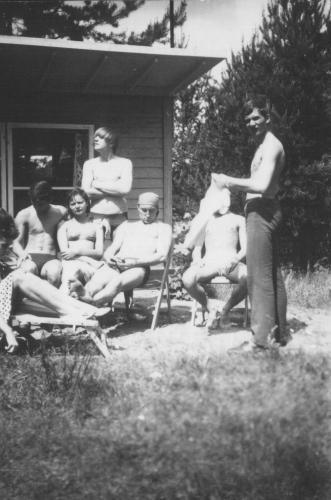
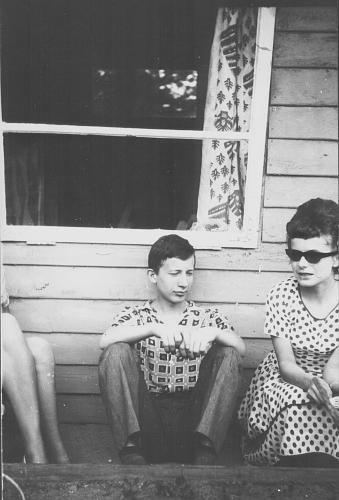

1965 - by Lake Mielno
Above, from the left: Jola Doniec (voc), Czesław Popielarczyk (voc), Joanna Makiej (voc), Roma Doniec (voc), Ryszard Szczudłowski (lead guitar)Photo: Stefan Rzytki 
1965 - the café by Lake Mielno
The café by Lake Mielno (Masuria) as it was in 1965 - this terrace did not exist then. It was the place of the evening dances for holidaymakers at the resort of the CRZZ - the Central Council of Trade Unions - with music by the band Ryszardy. Downstairs there was a "garage" for the resort manager's sailing boat and storage for the kayaks.
As a reward for its results and achievements, the band and its singers were treated to a two-week holiday at a resort in Masuria (Gierzwałd) on Lake Mielno.
1965/1966
The end of 1965 brought more changes. In October Eugeniusz Jakubowski left for military service. The band festival in Płock was just around the corner. In the meantime the Giełda Piosenki (Song Exchange) was held in Kraków, at the Dom Plastyka in Łobzowska Street, and the band took part. The entry was submitted by the ZDK, and the song to be presented was "Moja czarownica", to words by W. Dymny and music by... I think Romuald Ortel. The rehearsals - with the composer present - took place 2 or 3 days before the contest. Despite the "hole" in its instrumental line-up, the band took part.  Radek Ratyński Through her contacts Asia Makiej brought in, from the Korczak House of Culture (the Scouts' House), Radek Ratyński -  Ryszard Murak
who replaced Gienek Jakubowski; Ryszard Murak from the band Wiślanie also joined - as a new singer. Another line-up, getting used to playing together and.. on 14 November 1965 the trip to the National Band Festival in Płock, under the care of Stanisław Daniłoś from the ZDK. The newspaper Sztandar Młodych reported: "..Bands from Płock, Racibórz, Chwałowice, Rybnik, Lubin, Nowa Huta and Turoszów took part in the Festival. The best club band was judged to be BRYGADA from Turoszów. No second prize was awarded; the third went to the band Ryszardy from Nowa Huta". Słowo Powszechne wrote: .."5 thousand spectators watched the performances of 11 youth bands. First place went to the band "Brygada" from Turoszów.. ". Walka Młodych wrote: "..For several months now, across the length and breadth of Poland, the big beat has been resounding, and satellite bands imitating The Shadows and The Beatles have been springing up as fast as innovations in Warsaw's public transport. The Płock Festival is a good example: as many as seven big-beat bands appeared. Zbowersi, Ryszardy, Wiatraki, Ryzykanci, Mezony, Marabut, Cuprim - black jackets, red jackets, blue suits, and of course guitars, guitars, guitars... The colours changed as in a kaleidoscope, the music stayed the same, only played a little better, sometimes a little worse(...). 
The bands taking part in the festival also gave concerts in the surrounding area - Ryszardy were allotted Sierpc. The singers Asia Makiej and Ryszard Murak had a great success. There was also a trip to Warsaw. Lots of memories and impressions, and high spirits after the successes we had won.
1966
A popular event was "Mikrofon dla wszystkich" (A Microphone for Everyone). On 24 January 1966, in the "Wisła" hall, many amateur soloists took part in a 40-item programme. Asia Makiej won great acclaim with "Woskowa laleczka" (Poupée de cire, poupée de son).
 Jerzy Szwejkowski Another change of line-up followed. Jurek Konieczny left for the band Szwagry. Radek Ratyński brought over from the band Wiślanie Jurek Szwejkowski, who became the new bass guitarist. A short time later the singer Stefan Rzytki followed Jurek Konieczny. Another line-up, and more events, performances and contests. The ZDK ordered new amplification for the guitars and microphones. An elegant 100 W amplifier and four large speaker cabinets. That was real power at last (100 W) and a fine sound for the instruments. The band was also treated to new suits, made by Moda Polska. 


1967 - the swimming pool in Kraków - Nowa Huta
The pool by the reservoir and the girls on a return visit to Poland, whom we had met in the capital of the former East Germany, in Berlin - Adlershof, during the concerts of the band Ryszardy in the summer holidays of 1966.Above: Ryszard Szczudłowski, Karin, Jutta, Ryszard Jakubowski, Marianne (wo sind Sie....), Zbigniew Szczudłowski, Marek Pawlak - later of Telstar, Dżamble Photo: Jerzy Rzepa The summer season began with performances by the reservoir in Nowa Huta. The occasions were the Youth Days and Steelworker's Day. Our successes so far qualified the band for a trip to the international youth camp of the Baltic countries ("Internazionales Sommer Zelt Lager") at Graal Mueritz near Rostock, in the former East Germany. Preparations, a concert on 30 May in the cinema and theatre hall, and on 15 August the departure for the camp in Germany. Among Swedes, Norwegians, Danes, Finns and Russians there were many meetings and excursions and, of course, concerts in Rostock, in Berlin and on the spot at the camp. Personal friendships were made here too.  Marek Pawlak  Zenek Rybarczyk The return on 30 August .. September and.. my departure from the band, dictated purely by ..my school-leaving exams. After I left, Marek Pawlak came over from the band Wiślanie as rhythm guitarist, and Radek Ratyński took over the role of lead guitarist. In the autumn Ryszard Binias left for military service and his place at the drums was taken by Zenek Rybarczyk. In the photo above: Jutta and Karin - Berlin Adlershof 1967
On 17-19 March 1967 - as Sztandar Młodych reported - the National Review of Instrumental Groups, Vocalists and Singers was held in Tychy and Łaziska Średnie, organised by the Central Council of Trade Unions - the CRZZ. Out of 1415 groups entered for the qualifying rounds, 50 were admitted to the central review. The jurors included - among others - Andrzej Kurylewicz. In the beat-group category the places were awarded as follows:
The band worked in the line-up given above until the autumn, in the meantime also changing its name to Popioły. That name had been thought up by Radek Ratyński back when he played with Zenek Rybarczyk at the Korczak House of Culture. Since two of the Ryszards were no longer in the band - only Ryszard Murak remained - Radek Ratyński revived it, changing the name Ryszardy to Popioły. Zenek in turn - after later leaving the band - carried it over to Pięciu znad Wisły.
 Gienek Górski part of the repertoire consisted of the original compositions of Radek Ratyński. In the autumn Zenek Rybarczyk was replaced at the drums by Gienek Górski. Also in the autumn Radek Ratyński left for Szwagry and later for Skaldowie, while Zenek Rybarczyk left for the band Pięciu znad Wisły - taking the name Popioły with him for that band. 1967..
Although Ryszardy had turned into Popioły, something more could still be done. 
Ryszardy was the longest-playing guitar band of the 1960s in Kraków - Nowa Huta, but not the only one. Earlier, before 1963, the bands Biała Gwiazda and Ametysty played at Ognisko Młodych on the Młodości estate (the Violinka club). At the Lenin ZDK, at the evening dances in the large hall of the Song and Dance Ensemble, the band Kon-Tiki played, and later Czarne Koty; at the so-called THM, the band Czarne Diamenty, later Popioły and Nikt Nic Nie Wie; at the Tobacco Works in Czyżyny, the band Zefiry; and at the Violinka club on the Młodości estate, the band Bezdomni, later Wiślanie, as well as Big5 and Ab Ovo. I should also mention the bands about which I have little information but which helped to create the beat atmosphere of the 1960s in Kraków. They were: Poganie, Słowianie Bezimienni (on the site since 2017), Krakusy (on the site since 2006).... I am convinced that I will manage to reach further sources and friends from those years, which will make it possible to keep the site regularly updated. 
The main entrance to the ZDK
The main entrance to the Song and Dance Ensemble. This is where our Zorba the Greek stood, keeping watch over the entrance to the hall.

View of the main entrance
View of the main entrance to the Song and Dance Ensemble from the opposite side. Today the blue boards show the range of services offered by the ZDK.

The Song and Dance Ensemble from the courtyard
The Song and Dance Ensemble today, seen from the courtyard. Those trees were not there in the old days. There was an empty yard and a grey building, and it was colourful and cheerful inside - when the bands were playing there.
The line-ups of the band Ryszardy from the different years of its activity can be seen in the table. More information about the bands of the 1960s in Kraków - Nowa Huta can be found by following the text links on the band names or by going to The 60s. The details about them come from my own collection and from the people named in the acknowledgements, in particular former members of those bands. The amount of information on the site - seen from today's perspective - is not a complete record; it reflects the amount of material made available and the details checked with former members of the bands.
Nowa Huta is the district of Kraków where the musicians of many later Kraków bands had their early musical episodes. Taking Ryszardy as an example: Marek Jamrozy, and Andrzej Zieliński and Radek Ratyński, who play to this day in the band Skaldowie. Marek Pawlak - later in the bands Dżamble and Wawele. Ametysty - with small changes of line-up - were the forerunner of the later Szwagry; Jerzy Konieczny - in the band Szwagry. Asia Makiej was later, for many years, in the Jagiellonian University ensemble Słowianki. Roma Doniec devoted herself professionally to music, including Greek music with singing - Sirtaki; Jola Doniec works professionally to this day at the NCK (the Nowa Huta Cultural Centre). As a duo with Roma they later won many prizes in national contests and had their own television programmes. From Zefiry and Górale: Jan Wojdak - Wawele; from Ametysty: Tadeusz Gogosz, who played, among others, with Skaldowie, Dżamble, Czesław Niemen and Akwarele...
If you would like to hear this melodic, instrumental music -
as played today by the former lead guitarist of the band
Ryszardy - click on a title below..
Click - listen to the tracks
Wszystkie nagrania w STEREO
0:00
/
0:00
50%
1. Lilla Vacra Ana
2. Atlantis
3. Valla Bay
4. Dream Of Glory
5. The Golden Sea
6. Secrets Of The Sea
7. The Stranger
8. Peace Pipe
9. Wonderful Land
10. Jessica
11. The Golden Street
12. Santa Ana
13. Little Princess
14. FBI - mono
15. FBI - stereo
16. Shindig
17. Theme For Young Lovers
18. The Filleted Place
19. The Savage
20. Cosy
21. Blue Day
22. Blue Star
23. Apache
|




2003 - 2026 Kraków