
MARGARETKI a bit of history..
The year 1965 was an exceptionally important one for many girls living in Nowa Huta. No wonder, then, that the date stayed deep in their memory for a long time, perhaps even for ever. In that memorable year "Estrada Piosenki" was formed and began its activity at the Children's Club of the Lenin Steelworks (HiL) House of Culture. Before long the group took the charming name "Margaretki" ("The Daisies").
In the early phase of its existence, the level of the girls' musical and vocal skills did not yet promise brilliant artistic achievements, nor appearances in concerts on the most respected stages. It must be said, however, that its first performances met with very warm approval from the audience - youth and charm are not bad assets either.


 As early as the following year, the appearance of "Margaretki" at an event organised for the "Days of Youth" proved clear progress, both in the choice of songs and in the quality of performance. Their tutors saw to that: K. (Katarzyna) Florek, who looked after voice production and stage form, and Andrzej Dutkiewicz, who watched over the musical side.
Every passing year brought "Margaretki" visible changes in quality: new songs in the youth style had a strongly pulsating rhythm and a more ambitious harmonic sound, and static stage pictures turned into action with space and movement, not without simple dance interludes.

 The third year of the group's existence already brought a dozen or so performances, enjoying ever greater success, which boded well for its further development. And when K. Florek and A. Dutkiewicz, in optimistic mood - with redoubled effort and an enriched creative concept - continued the work on perfecting the programme, several girls - presumably on an ill-considered impulse - left the group towards the end of the calendar year.

 At first the tutors, dismayed by this fact and faced with a dilemma, quickly realised that there is no situation without a way out. I had the "doubtful honour" of being the head of the Children's Club at the time, so I proposed organising, at short notice, a children's song contest.

 Beyond all expectations it brought a rich harvest of girls who stood out musically and vocally, and the most gifted of them joined "Estrada Piosenki". The talented boys and a few younger girls, in turn, formed a new group called "Żonkile".
The new girls chosen in the contest - intended for "Estrada Piosenki" - thanks to their musical talents and better (than their predecessors') vocal predispositions, adapted relatively very quickly and became the core of the group. As a result, after a short period of consolidation, this gave "Margaretki" valuable artistic qualities and allowed the performances to resume. Another new element was the merger of "Estrada Piosenki" with the group "Żonkile", which made it possible to create a new formation called "Teatrzyk Piosenki".
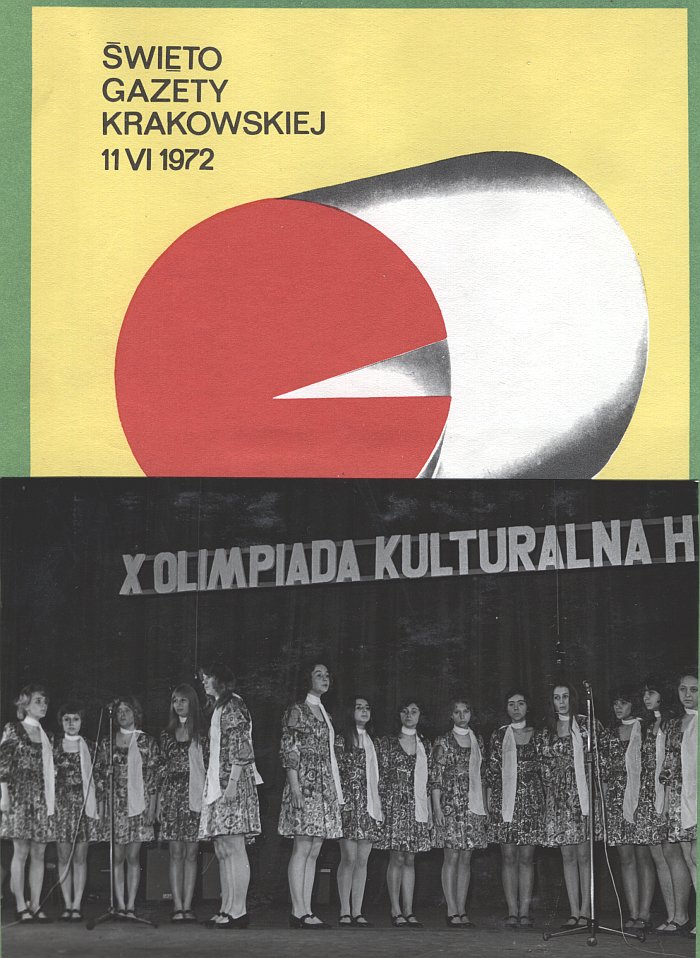
 Already its appearance at the event devoted to the HiL Cultural Olympiad was recorded by "Teatrzyk Piosenki", with its new formal and artistic profile, in its chronicle as a fully successful "debut". Its success was all the greater because a ballet joined it, creating an interesting entourage on stage and bringing richer means of artistic expression. The stage formula of the little theatre shaped in this way became the starting point for creating the visual layer, based on evolutions of movement and space, with an added dance routine.


 The cultural year 1968/1969 passed for "Teatrzyk Piosenki" under the sign of extremely hard work on a new repertoire of songs written specially for it by their authors. Their dominant theme was Nowa Huta - then an autonomous town - conceived mainly for the "Carnival of Youth" in Nowa Huta. And that was not the only reason for the hard work: in that cultural season the little theatre performed 27 times. Among the events of higher rank and importance were: taking part in a broadcast of Polish Radio in Kraków, in two broadcasts of the artistic radio station, an appearance at the nationwide event entitled "Mikrofon dla wszystkich", and the presentation of its programme on TV entitled "Dla każdego coś miłego".

 Paradoxically, an equally important event was the seminar organised at the Kraków House of Culture for instructors of artistic groups working in the city and beyond. The programme performed by the song theatre served as the basis for a workshop analysis. Its aim was to look for model methods of staging a programme and of achieving the best means of artistic expression.


 And so "Margaretki" found themselves facing a small jubilee, their 5th anniversary, a dividing line between the time of reaching a respectable level of performance and the stage which, in the near future, was to allow them to approach the peak of artistic success - bearing in mind that this was the amateur artistic movement. So every further year of activity of "Teatrzyk Piosenki" was marked by a drive to raise the artistic bar visibly and to meet new audiences in other regions of the country and abroad, in order to win the widest possible crowd of fans.
The 5th anniversary celebrations of "Margaretki" were a series of events, among which the following can be counted as of high rank: another recording on the air of Polish Radio in Kraków, taking part in the concert for the 20th anniversary of Nowa Huta, held in the steelworks' sports and entertainment hall, and an appearance on TV Katowice in the nationwide programme entitled "Bawcie się razem z nami". A presentation of the programme in different visual and repertoire "garments" for the city harvest festival.


 A particularly momentous event for "Margaretki" was the trip to the GDR for the Days of Polish Culture. From 21 to 28 October 1970 an artistic tour took place, and the concerts given by "Margaretki" on a number of theatre stages in many towns were received with real ovations. Taking part in the trade unions' cultural festival was also a significant success, and above all winning the title of laureate.
The balance of five years of work of the group "Margaretki" was not dazzling, yet significant artistic achievements and a considerable number of performances are not a mere courtesy statement: "..even, pleasant-sounding, carrying voices, girls who truly radiate charm, sparkle with smiles and captivate with their looks. They have correct diction and emotional commitment, climbing ever more difficult rungs of musical and vocal initiation.. ".
A classic example of a "job well done" may be the song entitled "Cała jesteś w skowronkach" : a true masterpiece, written by "Skaldowie" - performed by "Margaretki". This quotation, taken from the group's chronicle, conveys the spirit of truth (even though I was its author), as it was written down at the time - not from the perspective of half a century.

 The beginning of the next five years turned out extremely happily for "Margaretki", as they had the extraordinary honour of taking part in a concert whose proceeds went towards buying the "Atma" villa in Zakopane - the future Karol Szymanowski museum. The girls, of course, sang a song by this outstanding composer for an audience of two and a half thousand in the sports and entertainment hall, and the concert was hosted by the eminent music critic and columnist Jerzy Waldorff. That great event was not only a reason for enormous satisfaction for "Margaretki"; it also proved that the performers of very difficult songs had talent and musical versatility.
The following years were a whole series of performances of varying importance and artistic rank. Worth stressing are such events as: a concert for miners on St Barbara's Day (Barbórka) in Trzebinia-Siersza, and taking part in the music and dance show "Przedmieście" - on Steelworker's Day in the sports and entertainment hall - another example of the group's widened range of performing abilities.


A performance on the Kraków Main Square for the Gazeta Krakowska Festival. Performances for steelworkers taking part in the cultural olympiads of the HiL departments.


 An undoubtedly important distinction for "Margaretki" was taking part in the "Soldiers' Song Festival" - Kołobrzeg '72 and in the "Song Festival" Sanok '73.

 The repertoire and performing range of "Margaretki" was enriched with new elements many times. So it was this time too, as proved by the staging of the Kraków suite and the Silesian suite. This changing face of the group allowed it to go on an artistic tour together with the House of Culture's song and dance ensemble: to Bulgaria - Sofia, Plovdiv, Varna, then to Hungary - Dunaújváros, and to what was then Czechoslovakia - Košice.


 In 1974 it fell to "Margaretki" to travel to Kiev, where twice, together with Kiev groups, they took part in a concert broadcast by the local television. It is hard not to share the girls' view that the concerts abroad should be counted among the special events they took part in, as it was these that gave them the most experiences and particular fun.
So passed the years of artistic activity of "Margaretki", who did not only mature biologically; they won ever finer spurs of musical craft, and artistic successes multiplied both at home and abroad. They took honourable places in various festivals. The number of performances added up impressively, and the consequence of all this was the moment when the calendar set them another jubilee. This time the jubilee of 10 years of artistic achievement.
The 10th anniversary celebrations took the form mainly of many concerts, feted by the audience, but above all by the girls themselves; in the form of all kinds of distinctions, honours and rewards. And most importantly, the jubilee concerts became a synonym of the highest artistic level. In this way the persistent efforts of the tutors and the girls to reach the peak became real.


 And - what a paradox! - what conclusion could appear in the heads of the group's management when, in this situation, several girls moved to the group "Słowianki"?.. Well, once again a banal-sounding thought made itself heard: "there is no situation without a way out". How unfailingly history likes to repeat itself.
"Margaretki", now only five in number, once again dedicated their vocal and musical productions to the readers of Gazeta Krakowska, and together with the well-known band "Wawele" they appeared at the Youth Festival in Białystok. Once more they went to the "Soldiers' Song Festival" in Kołobrzeg, winning laurels in the form of a distinction.

 They gave a whole series of further performances for various institutions, on Steelworker's Day - at the music school, and on International Children's Day in the sports and entertainment hall. Nor did they shy away from smaller events, addressed to various communities outside Kraków. And the crowning of those artistic explorations was the tour of Yugoslavia..
And here ends the very rich history of the group "Margaretki", marked by a string of remarkable highs, but not free of unwelcome situations either - as in life. The group "Margaretki" was a phenomenon of its own kind, with no parallel in the '60s. And not only in the amateur movement but in the professional one as well. In the '70s there appeared "Teatrzyk Wiolinek", with an artistic formula similar to that of "Margaretki".
To conclude the story of the group "Margaretki", it is worth stressing that the final stage of its artistic career was crowned with professional status. And what can justify that professional status? - these values, recovered from a reel-to-reel tape - five-part harmony studded with dissonances, sprinkled with syncopation, and at times polyphonic voice leading, absolutely correct articulation, flawless intonation. And finally the association of many artistic cultures: singing, evolutions of space and movement, acting, dance.


 And besides: - from the earlier and the final line-up - 3 girls were engaged by the Kraków Philharmonic choir, one - by the Polish Radio choir, two - by musical theatres, two - making up for my own unfulfilled vocal aspirations - sang on several continents.
In the epilogue - of a history of the group "Margaretki" shown perhaps at somewhat excessive length, but is it not in proportion to the scale of its activity and successes? - it is hard not to add that the main credit for it belongs to the artistic management: Kazimiera - Katarzyna Florek and Paweł Bieńkowski, and also to those who earlier accompanied on the piano: Andrzej Dutkiewicz and Stanisława Piątkowska.
In creating that colourful history of the group, an essential part belongs above all to the performers, faithful to their pledge to serve the group and their fans to the end. And here are their names: Aniceta Florek, Marlena Florek, Małgorzata Marędziak, Barbara Sakowska, Elżbieta Wójcik.
My good spirit in the person of R. Szczudłowski made me aware of the need to include the musicians: Zbigniew Balicki, Andrzej Radniecki, Ryszard Idzi, Zdzisław Nazarko - drums; Andrzej Dutkiewicz, Eugeniusz Lewicki, Zbigniew Ząbek, Juliusz Malik - double bass.
Gallery - 1965 and later..
Click to enlarge
Remember the names? - write to me




Listen to songs performed by MARGARETKI - 1973
Click - listen to the songs
0:00
/
0:00
50%


Copyright © Ryszard Szczudlowski
2003 - 2026 Kraków
2003 - 2026 Kraków